Texas is the largest manufactured housing market in the country, and also one of the most fragmented to permit in. If you sell or install across county lines, you already feel it: the rules that cleared a home in one county bounce it in the next. This post lays out the landscape, covering how the system is structured, what's changing right now, and why it works the way it does so that you can see the whole board instead of one county at a time.
How the System Is Structured
Every manufactured home installation in Texas follows two separate tracks, and understanding that is key to grasping the whole landscape.
The first track is the state. Manufactured homes are regulated by the Texas Department of Housing and Community Affairs (TDHCA) through its Manufactured Housing Division, under the Texas Manufactured Housing Standards Act and 10 Texas Administrative Code Chapter 80. This layer is constant, applying statewide. It covers anchoring, installation standards, and the Notice of Installation (Form T) that licensed installers must file after every home.
The second track is local. Each county, and within it each city or building authority, adds its own requirements on top of the state baseline: zoning, floodplain rules, septic, and where a manufactured home may legally sit. This is the layer that varies, and it varies across more than a thousand jurisdictions statewide.
So when dealers talk about a permit being "different" in another county, they're rarely talking about the state track. That part is stable. They're talking about the local track, and that's where most of the time, cost, and rejection risk live. A useful way to picture it: one fixed state foundation, with roughly a thousand local variations stacked on top.
A few constants worth knowing across the whole landscape:
- A home must carry its HUD label; homes built before June 15, 1976, are treated as a different legal category entirely.
- Any engineered foundation (a special foundation system, an insulated foundation, or a monolithic slab above the frost line) must be designed by a Texas-licensed professional engineer or registered architect.
- Flood zone status, set by FEMA's FIRM maps, changes documentation and elevation requirements in many counties.
What's Changing: SB 785 and the Map in Motion
The Texas landscape isn't static, and right now it's moving in a way every dealer should be watching.
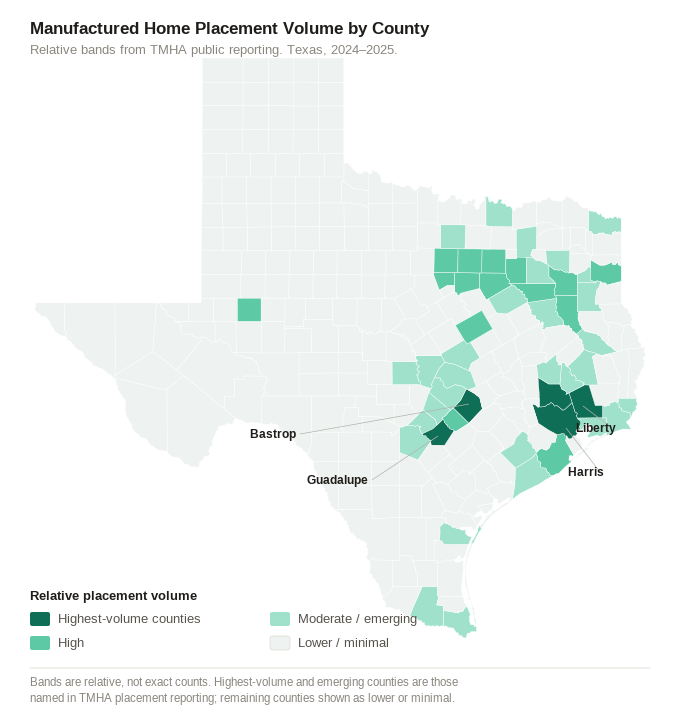
SB 785 takes effect in September 2026, within weeks of this writing. It expands the structured permitting framework into a new set of Texas counties, bringing markets like Hidalgo, Cameron, McLennan, Nueces, Bell, and Gregg into clearer reach. For a dealer, this isn't abstract policy. It's a new territory opening on a known timeline. The operators who map those counties now — building authorities, requirements, and contacts — will be ready to submit the week the change lands, while others are still figuring out who to call.
The active core of the market today sits in counties like Liberty, Montgomery, Brazoria, Harrison, Cherokee, Smith, and Guadalupe — the places where manufactured home volume and workable permitting processes already line up. Placement growth is real and shifting: counties on the I-35 corridor and the outskirts of the major metros have seen some of the strongest year-over-year increases in new home installations.
The takeaway: think of Texas as a map with two layers of opportunity — the counties producing volume today, and the Tier 2 counties about to open under SB 785. Working both is how you stay ahead of the field instead of reacting to it.
Why Texas Works This Way
The fragmentation isn't an accident or a failure. It's the product of how manufactured housing came to be regulated at three levels that don't quite line up.
At the federal level, the HUD Code (24 CFR 3280 and 3285) standardized manufactured home construction and installation starting June 15, 1976. That date is why the industry draws a hard line between a pre-1976 "mobile home" and a post-1976 "manufactured home," since they're built to different standards and treated differently in law. The red HUD label on a compliant home traces directly back to this federal framework.
At the state level, Texas layered its own administration on top through the Manufactured Housing Standards Act, giving TDHCA authority over how homes are installed and reported once they're on Texas soil. This is the uniform state track: one set of rules, one Form T, statewide.
The local level is where the fragmentation enters. Counties, cities, and building authorities each retain authority over land use, floodplain, and where homes can be placed. Multiply that across the state, and you get the more-than-a-thousand-jurisdiction reality dealers navigate today. No single agency consolidated it, because the authority was never centralized in the first place. It was distributed by design — federal to state to local.
For a dealer, the practical lesson from history is the same as the lesson from the structure: no one desk approves a Texas home. Clearing the landscape means clearing every layer, in the right order, in whichever county the home is going.
Stampd handles manufactured home installation permits across Texas, covering the constant state track and the variable local one in whichever county your home is headed. We map the jurisdiction, prepare the package, and verify it against that county's specific requirements before it goes in. If you're moving homes across more than one county line, talk to us about covering the whole map instead of chasing it one county at a time.